
The Thesis
AI vendor policy became constitutionally protected this week, and with frontier models converging on performance, the enterprise procurement decision just shifted permanently from "which model is best" to "which vendor's risk posture fits ours."
The Signal
Three moves that repriced vendor risk this week
1. A federal judge blocked the Pentagon's Anthropic ban, calling it "Orwellian."
Judge Rita Lin issued a preliminary injunction on March 26 barring 17 federal agencies from enforcing the supply chain risk designation against Anthropic, finding the action was "classic illegal First Amendment retaliation" for the company's refusal to allow Claude in autonomous weapons or mass surveillance systems (CNBC, CNN, Defense One).
The ruling establishes that an AI vendor's decision to maintain usage restrictions is protected speech, not a security threat. Every enterprise buyer negotiating AI usage terms now has a federal precedent confirming that vendors can hold safety boundaries without being disqualified, which means procurement teams need to evaluate vendor policy as a durable feature, not a negotiable concession.
2. The White House released its National AI Policy Framework, proposing federal preemption of state AI laws.
On March 20, the administration published legislative recommendations calling for a unified federal AI standard that would supersede state-level AI regulations, with no new regulatory body and a "light-touch" posture that defers copyright questions to courts (White House, DLA Piper, Holland & Knight).
The framework signals the administration's intent to consolidate AI governance federally, but Congress has already rejected comprehensive preemption twice, and Democrats introduced the GUARDRAILS Act the same day to block it. For operators, this means the state patchwork persists: compliance teams cannot wait for federal clarity that may not arrive this year.
3. Frontier model benchmarks converged to the point where capability alone no longer differentiates.
As of April 2026, Gemini 3.1 Pro leads 13 of 16 major benchmarks, Claude Sonnet 4.6 leads real-world expert work evaluations, and GPT-5.4 ties Gemini at the top of the Artificial Analysis Intelligence Index, all within striking distance of each other (Renovate QR, LLM Stats). Open-weight Llama 4 Maverick now matches proprietary models on several benchmarks with a 10-million-token context window.
When four frontier models score within margin on the same tests, the procurement decision becomes about price, workflow fit, and vendor risk posture, exactly the variables the Anthropic ruling just repriced.
The Playbook
The Vendor Policy Procurement Audit: 5 questions to ask before selecting or renewing an AI vendor contract.
What usage restrictions does the vendor maintain, and are they contractual or discretionary? The Anthropic ruling confirmed that vendor-side restrictions are a legal right. Understand which boundaries are permanent policy versus negotiation positions.
Does the vendor's acceptable use policy create compliance risk or reduce it for your organization? A vendor that prohibits certain use cases may actually lower your regulatory exposure, especially in sectors with fiduciary, healthcare, or defense obligations.
Can you swap models without rebuilding your integration layer? With four frontier models at near-parity, vendor lock-in is now primarily an integration risk. MCP-compatible architectures allow model rotation as pricing and policy shift.
Where is the vendor incorporated, and which jurisdictions govern their data handling? Federal preemption is proposed but unenacted. Your vendor's data practices are still subject to Colorado, California, Texas, and Utah AI statutes until Congress acts.
Has the vendor disclosed its position on government and defense use cases? After the Anthropic precedent, vendor defense posture is a material risk factor. A vendor willing to accept unrestricted government use may face different reputational and legal exposure than one that draws lines.
The Verification Test
The claim: Federal AI preemption will simplify compliance by replacing the state patchwork with a single national standard.
The test: Ask your legal team for the timeline: when does the Framework become enacted law, which state statutes does it explicitly preempt, and what enforcement mechanism replaces state attorneys general?
Pass criteria: Specific bill language identifying preempted state provisions, a named federal enforcement body with rulemaking authority, and a compliance transition timeline with safe harbor provisions.
Fail smell: The answer cites the Framework document itself as though it were binding law, references the December 2025 executive order as current authority, or assumes preemption is inevitable despite Congress having rejected it twice already in the NDAA and the One Big Beautiful Bill Act.
The Metric
13 of 16, and it doesn't matter.
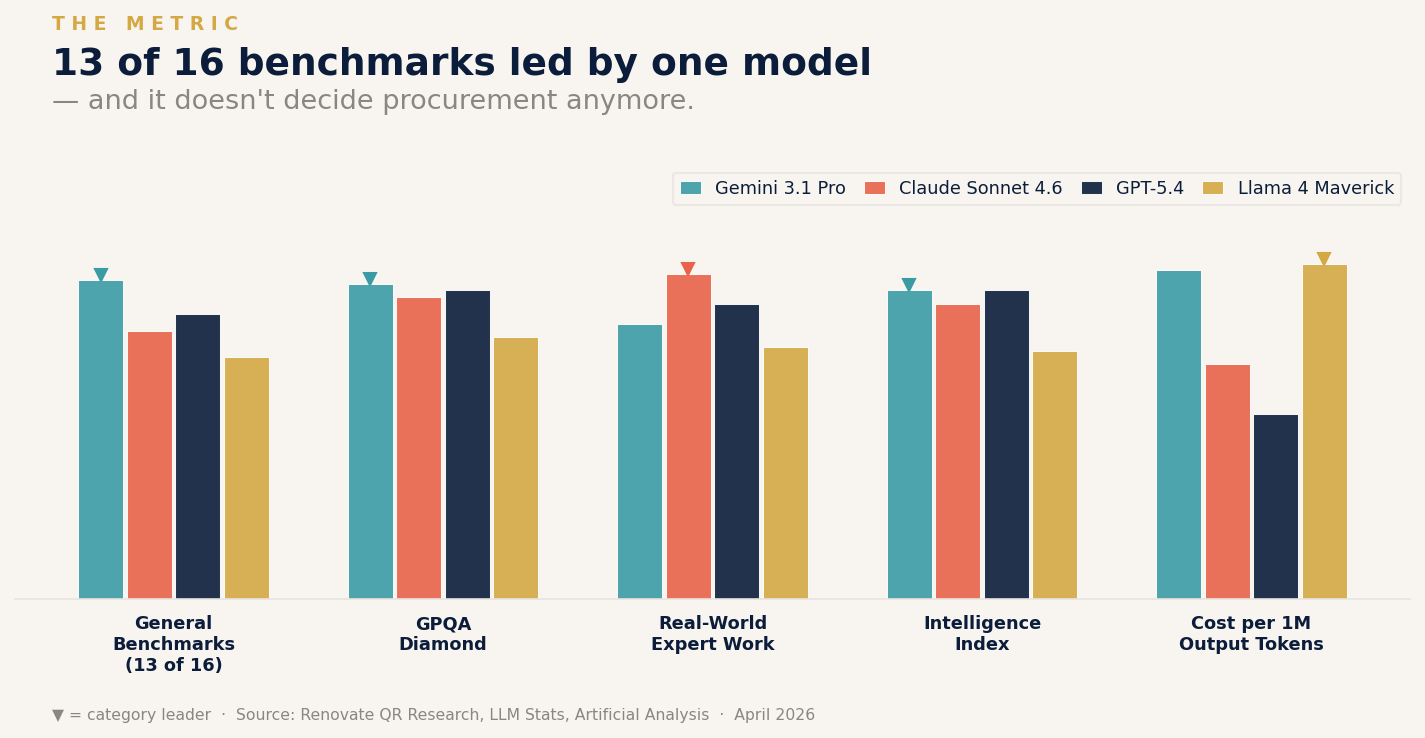
Gemini 3.1 Pro leads 13 of 16 major AI benchmarks as of April 2026. Claude Sonnet 4.6 leads the GDPval-AA Elo benchmark for real-world expert work. GPT-5.4 ties Gemini on the Artificial Analysis Intelligence Index.
When no single model dominates, the procurement differentiator shifts from capability to vendor economics, integration fit, and policy posture. The Anthropic ruling just elevated that last variable from a soft preference to a constitutional right. Buyers selecting AI vendors on benchmark scores alone are optimizing on the wrong axis.
Source: Renovate QR Research, LLM Stats, Artificial Analysis
The Lens
Horizon Search Institute
Human Performance: UC Berkeley found AI tools intensify work rather than reduce it, with 62% of associates reporting burnout from voluntary overuse. HBR
Responsible AI: Pentagon CTO called the Anthropic injunction a "disgrace" and signaled appeal; the supply chain risk designation remains contested on two legal fronts. Breaking Defense
Planetary Futures: The White House AI Framework asks Congress to ensure residential ratepayers do not subsidize data center energy costs, the first federal acknowledgment of AI's utility pricing externality. White House
Governance & Diplomacy: Democrats introduced the GUARDRAILS Act on March 20 to block federal preemption of state AI laws, setting up a legislative collision course. Holland & Knight
Links Worth Your Time
- Washington Monthly on the Anthropic ruling — The most thorough analysis of the government's legal brief, what the judge found pretextual, and why the word "Orwellian" was chosen deliberately.
- DLA Piper on the White House AI Framework — Clean breakdown of what the Framework actually recommends, where it defers to courts, and what compliance teams should do now.
- Renovate QR on AI models in April 2026 — Comprehensive benchmark comparison across all frontier models, including the Claude Mythos leak and what it signals about Anthropic's roadmap.
- FourWeekMBA on open model convergence — Argues the moat has collapsed from model capability to proprietary data, infrastructure scale, and product integration.
- Crowell & Moring on federal preemption — Notes what the Framework does not mention: bias, civil rights, post-deployment monitoring, or a dedicated AI enforcement body. The silences matter.
Sources
- CNBC — Anthropic wins preliminary injunction in DOD fight
- CNN — Judge blocks Pentagon's effort to "punish" Anthropic
- Defense One — Judge blocks Pentagon's Anthropic ban, calling it illegal retaliation
- Breaking Defense — Judge grants Anthropic preliminary injunction
- NPR — Judge temporarily blocks Trump administration's Anthropic ban
- Washington Monthly — The Pentagon's "Orwellian" Case Against Anthropic
- White House — A National Policy Framework for Artificial Intelligence
- DLA Piper — White House releases the National Policy Framework for AI
- Holland & Knight — White House Releases a National Policy Framework for AI
- Crowell & Moring — White House National AI Policy Framework
- Ropes & Gray — The White House Legislative Recommendations
- Renovate QR — AI Models in April 2026
- LLM Stats — AI Leaderboard 2026
- FourWeekMBA — Open Model Convergence
- HBR / UC Berkeley — AI Doesn't Reduce Work, It Intensifies It
The Searchlight is a weekly field memo from Horizon Search Institute. It is not investment advice. Views are the editor's own.